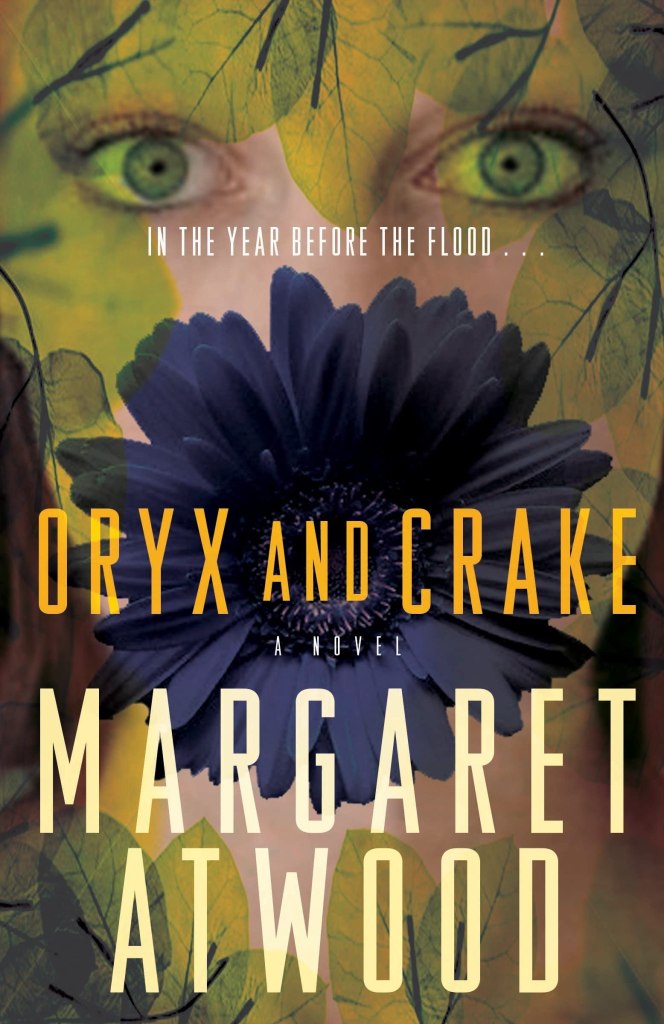
Among other things, speculative fiction provides an unparalleled forum to consider the long-term consequences of ideas and initiatives. Scientists, sociologists and economists often make predictions, of course, but professional specialization typically requires that such forecasts be tightly focused. Margaret Atwood’s Oryx and Crake (2003) is a model for how fiction can take a broader perspective to delineate how multiple, overlapping crises work together to create a dystopian nightmare.
Set in an undefined but not-distant future when global warming has made vast areas of the earth uninhabitable and corporations seemingly form the only government, the novel describes a world of rapidly diminishing resources and rampant inequality, where everything is for sale and life retains a semblance of order and normality only inside the gated communities reserved for corporate executives and top research scientists. This order, moreover, is only maintained by private security forces, who suppress threats to the corporations with immediate violence.
Crake, besides being a scientific genius, is a firm exponent of evolutionary psychology (more basically, the belief that everything people do can be reduced to an adaptation for natural selection). From this perspective, nothing that humans accomplish has any intrinsic or transcendent value. In one representative (and hilarious) passage, Crake condenses the entire history of art to a biologically motivated attempt on the part of the artist to achieve what he would call intergenerational genetic transfer:
The frog in mating season . . . makes as much noise as it can. The females are attracted to the male frog with the biggest, deepest voice, because it suggests a more powerful frog, with superior genes. Smaller frogs—its been documented—discover that if they position themselves in empty drainpipes, the pipe acts as an amplifier, and the smaller frog appears larger than it really is.
. . . . .
So, that’s what art is, for the artist, . . . an empty drainpipe. An amplifier. A stab at getting laid.
Crake’s study of human history has convinced him that humans are simply too aggressive, impulsive and short-sighted to be a responsible apex species (“[m]onkey brains . . . [m]onkey paws, monkey curiosity, the desire to take apart, turn inside out, smell, fondle, measure, improve, trash, discard”). As environmental conditions continue to decline and a catastrophic world-wide breakdown becomes imminent, he makes an audacious decision: he will release a virus that will quickly exterminate all human life: a new humanoid species he created will then be introduced. This species, called Crakers or the Children of Crake, are humans who have undergone extensive genetic modification that allows them to inhabit the badly-damaged environment without straining its resources: they’re herbivores, with skin is resistant to both ultraviolet radiation and insect bites; they’re biologically programmed to mate and raise children communally, enjoy perfect health until they die at the age of thirty, and are incapable of abstract thought. The implication is that they will exist in static, technologically undeveloped tribes indefinitely.
Does any of this sound familiar?
Some of it should, because Crake’s solution has some deep similarities to current anti-vaccination propaganda. Most specific is the assertion that the Covid vaccine is deadly and is part of a plan to reduce the world population. The idea of large-scale population replacement also corresponds to with current fears (and in the novel, before the extent of Crake’s plan becomes evident, some world leaders are interested in his research because of the possibility of bio-programming a population for “docility”). More generally, the novel also depicts a leadership defined exclusively by self-interest, as is again common with current conspiracy theories.
Now, obviously, it’s highly doubtful that the conspiracy theorists formulating such assertions were influenced by Atwood’s novel. Nonetheless, the parallels and illustrate the confusion that proliferates when metaphors are understood literally (I may have already discussed this issue).
A lot that could be said about these similarities, but the point I would like to discuss is how they illustrate the extent to which conspiracism is, fundamentally, a crowd-sourced novel, written in real time (although how much of its growth is organic is open to question). Like speculative fiction, it reflects the concerns of the era—for example, that the wealthy have too much power and corporations have agendas that do not always accord with the public interest. The great difference, however, is that with fiction we’re aware we are dealing with metaphors that relate to concrete reality only indirectly. With conspiracism, contrarily, the authors don’t realize they’re engaging in fictional world creation, and their metaphors are asserted as fact.
In response to the Qanon phenomenon, The New York Times published an article largely arguing that actual scientific research is simply too complex to evaluate, and that we should ignore articles that depart from scientific consensus. And I guess this makes sense: while that consensus does need to be constantly challenged if progress is to be achieved, it could be argued that this is work for trained experts. At the same time, however, the idea that we should leave our thinking to experts is elitist and anti-democratic, and also unlikely to win much support.
Maybe a better approach would be to encourage people to read actual fiction. Literary interpretation is an intrinsically speculative activity: it trains us to entertain ideas without necessarily committing to them, to consider their implications and use them to evolve our own understanding of reality. Without this, we become absolute in our thinking, prone to broad and uncritical assertion. And this, of course, is the essential pretext for conspiracism.
 Travel Only By Night